Essay 2
Al Borde del Río
A Pride march in Mexico City, watched from its edge — and everything the edge turned out to hold.
Ciudad de México — June 27, 2026
I watched this year's march from the edge of it. Not inside the river of people — beside it, on the curb, with a camera. I hadn't planned it that way. But by the time I arrived, the front had already passed, and the only way left to take part was to stand still and look.
So I looked.
Most of the faces were turned away — toward the music, toward each other, toward the front I'd missed. And then one wasn't: a young woman under a purple umbrella, a small rainbow painted on her cheek, looking back at me across all of it. Not posing. Just letting herself be seen.
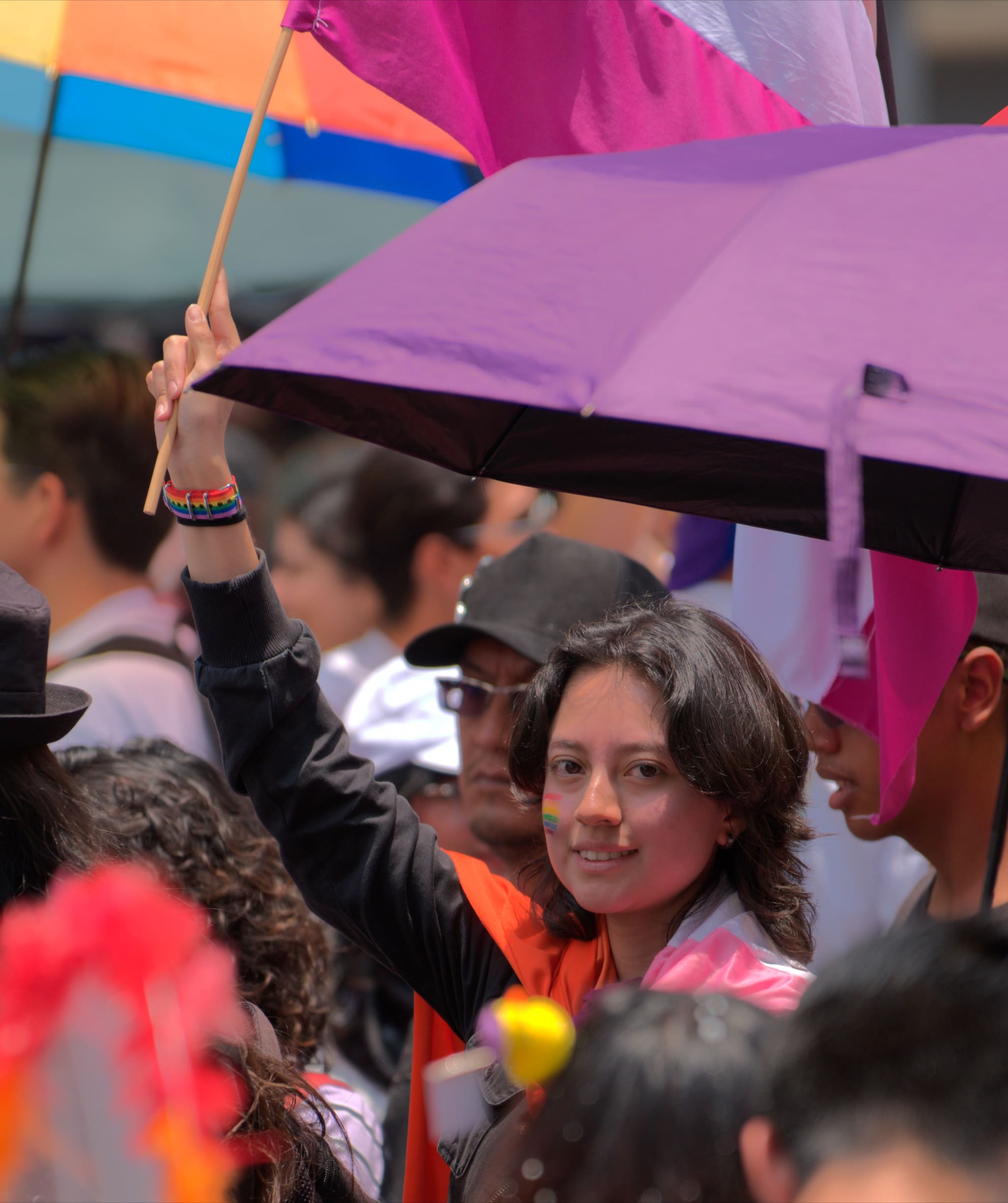
I don't know anything about her — what she'd come through, what she was hoping for, who she'd come with. I only know what I felt looking at her: a quiet determination, and hope. The early kind. The kind I'm not sure I can still feel from the inside, after the road I took to get here.
But I could see it in her. And seeing it gave some of it back to me.
That turned out to be the whole day. I'd come to march. Instead, I came to witness. It took me a while to understand those aren't the same thing — and longer to understand that the second is still a way of being there.
We had planned it differently. The day before the march, Alexis and I went out to Zona Rosa to gather small things for it — the kind of unserious errand that is really just an excuse to be in the city together while it dresses itself in color. We found what we'd gone for — flags, and small adornments of every kind. And then, just as we turned for home, the day turned too, the way days sometimes do, without asking.
A misstep on a broken street. An ambulance. And then a long evening in the emergency room, holding my love's hand under cool clinical light while the plans we'd made quietly left the room.
I won't render that evening in detail. It isn't only mine to tell. What I can say is that we came home late, with a splint and a bag of prescriptions and news we hadn't asked for, and that the person I love — who has spent years taking care of me, who watches over our home, who walks beside me on every adventure I've dared here — woke the next morning unable to walk beside me at all.

So the morning of the march, I wasn't pinning anything rainbow to my shirt. I was learning the Spanish word for crutches. Muletas. Our friend Raziel had stayed the night to help us, and where my Spanish ran out, his carried: he called the orthopedic shops while I searched for which ones might have the tall size, para una persona de un noventa — and then the two of us went out together to bring them home. I adjusted the height of them against my love's arms in our living room — two finger-widths below, weight on the hands — while somewhere in the city, a river of people I had meant to stand inside began to move without me.
I want to be honest: for a moment, that hurt.
And then it didn't, because the accounting is not close. Alexis has carried me through years that I did not know how to carry alone. One morning of carrying back is not a sacrifice. It is the practice the march exists to honor, performed at home, at the scale of two people: you take care of the person in front of you. The parade can be missed. This cannot.
By the time the crutches were fitted and the morning settled — by the time my love, stubborn and gentle, insisted I go — the front of the march had long since passed the Ángel. Raziel walked with me. I picked up the camera.
If I couldn't be inside it, I would go and see it.
We met the march already in motion. There is no other way to say it: we stepped out of a side street and into weather. Sound from every direction, cumbia off a speaker truck somewhere unseen, whistles, drums, a bass line you felt in your sternum before you could name the song. The hard June sun overhead, and beneath it, umbrellas in every color a flag has ever claimed — not for rain, but for shade and for joy, which that afternoon were the same thing.
I had missed the front. It did not matter. The march is not a thing that passes; it is a thing that keeps arriving. For hours it kept arriving.
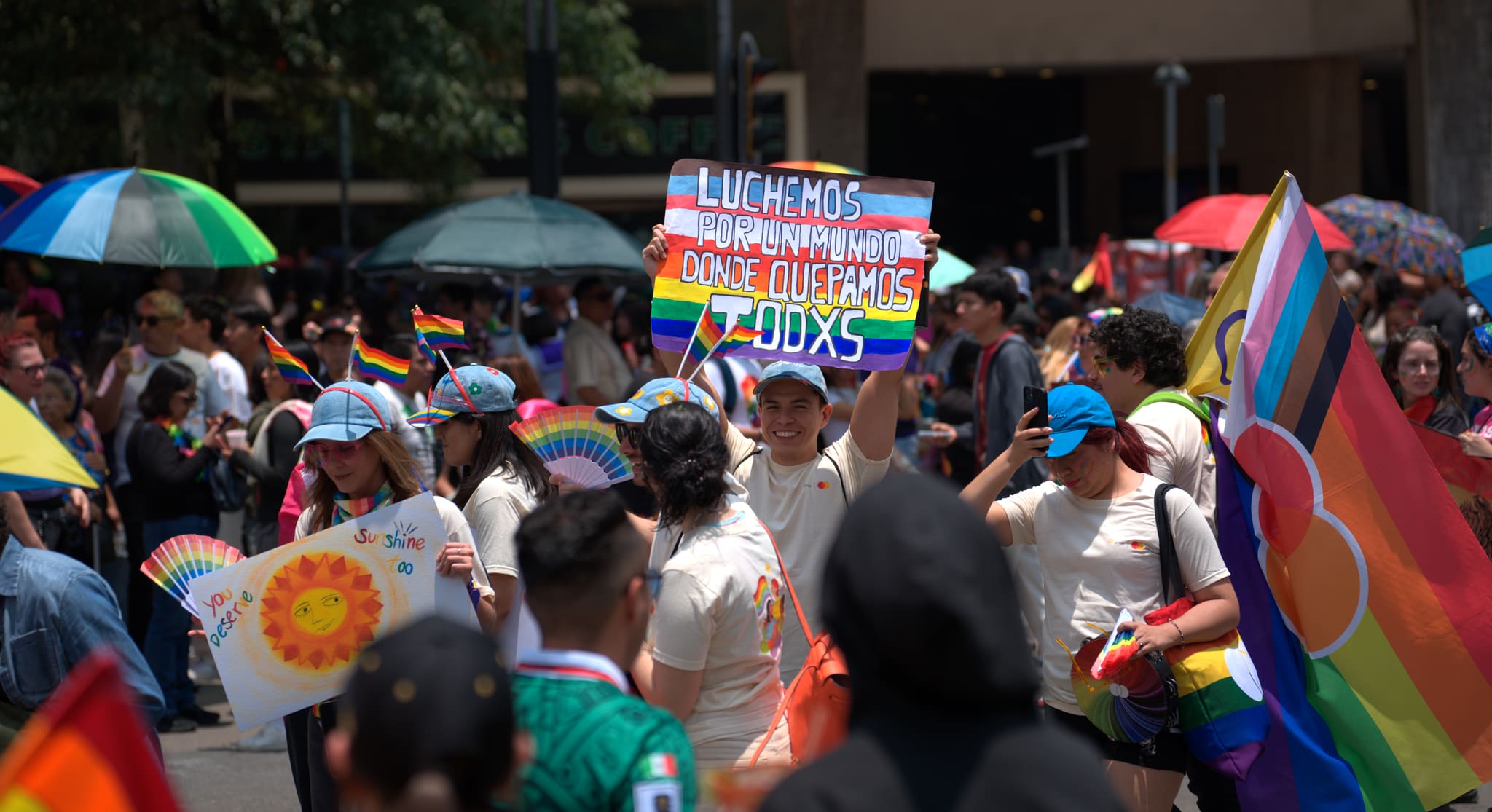
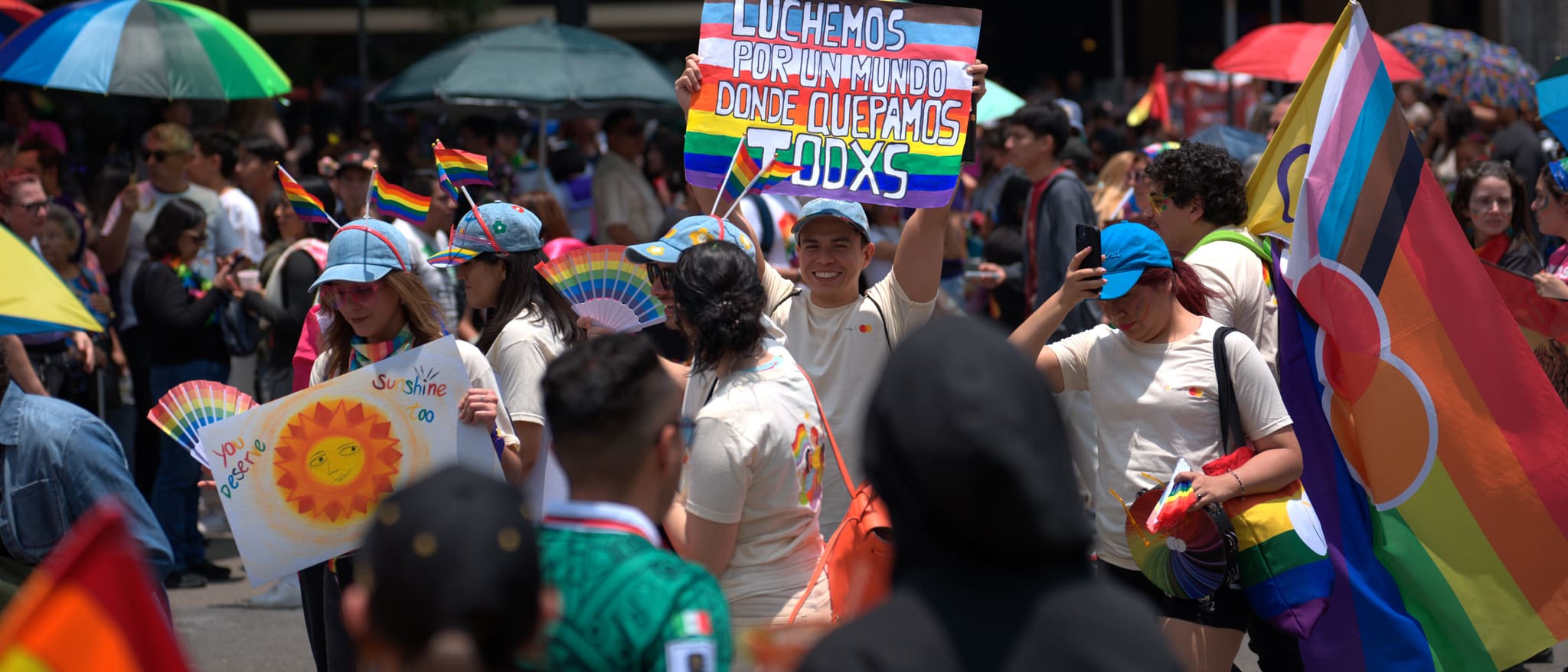
In the middle of the crowd, a man held a hand-painted sign above his head, grinning like the sun: Luchemos por un mundo donde quepamos todxs. Let us fight for a world where we all fit. I stood at the edge of the street and photographed a world trying to become that sentence.
And the city, being this city, kept both promises at once — the fight and the fiesta. A woman raised a black placard crowded with lipstick kisses: besos gratis, solo hoy. Free kisses, today only. In the corner of her sign, side by side, a little rainbow flag and the World Cup trophy — because this June, in this city, even the placards know both celebrations by name.
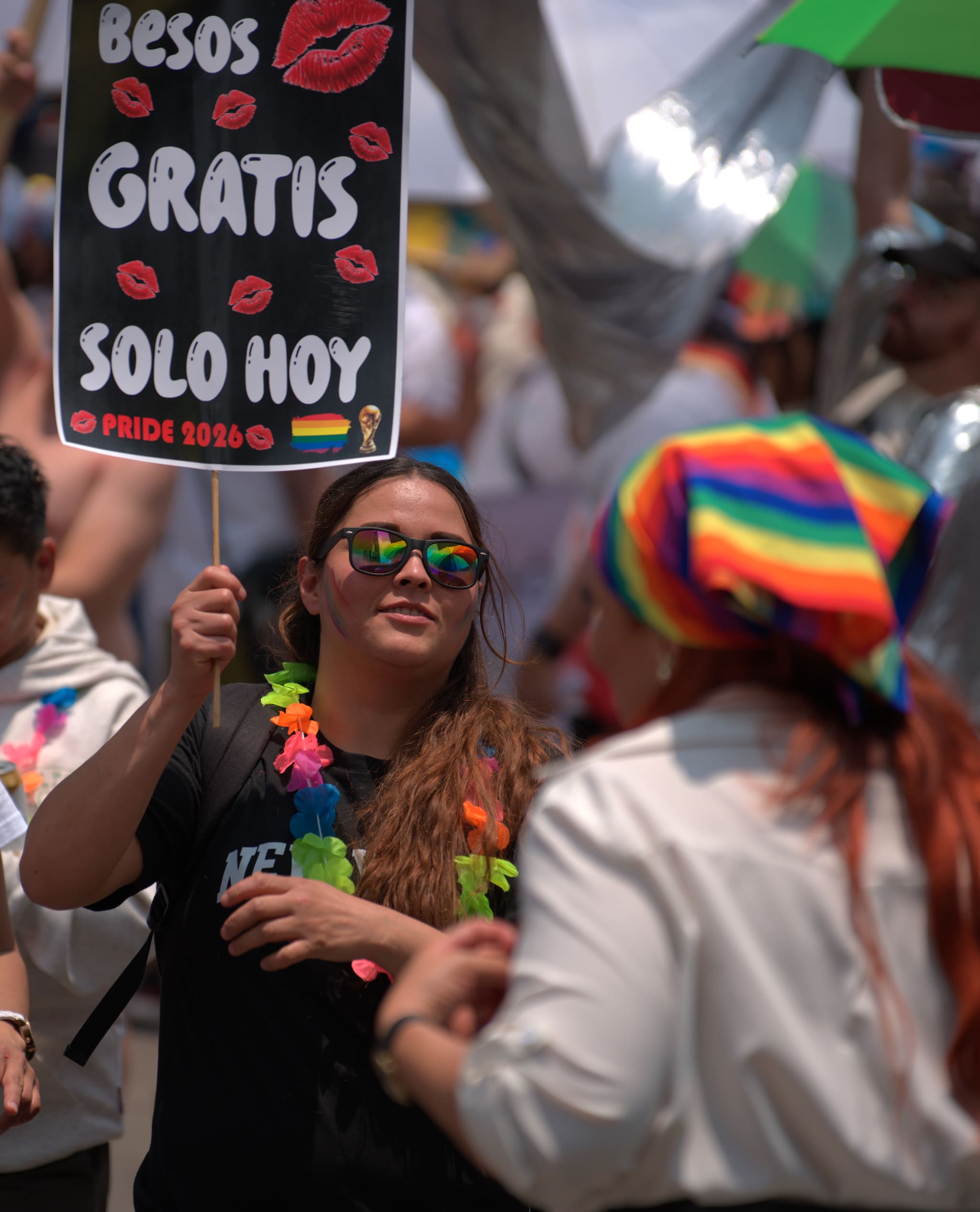
Solo hoy. I keep thinking about that. One day a year when affection this public costs nothing and risks nothing. The sign is a joke, and like the best jokes it is not.
Everyone marched. Colectivos behind hand-lettered banners. Families with folding chairs and coolers. Drag queens blessing the crowd from a candy-pink float like a heaven with better lighting. And the brands, too, in their matching t-shirts with their logos rendered in rainbow for the occasion — I photographed the whole afternoon on a camera whose maker was somewhere in that crowd handing out pride-lettered hats. I note this without ceremony. The avenue was wide enough that day for the cardboard and the corporations both, and everyone knew which one the day belonged to.

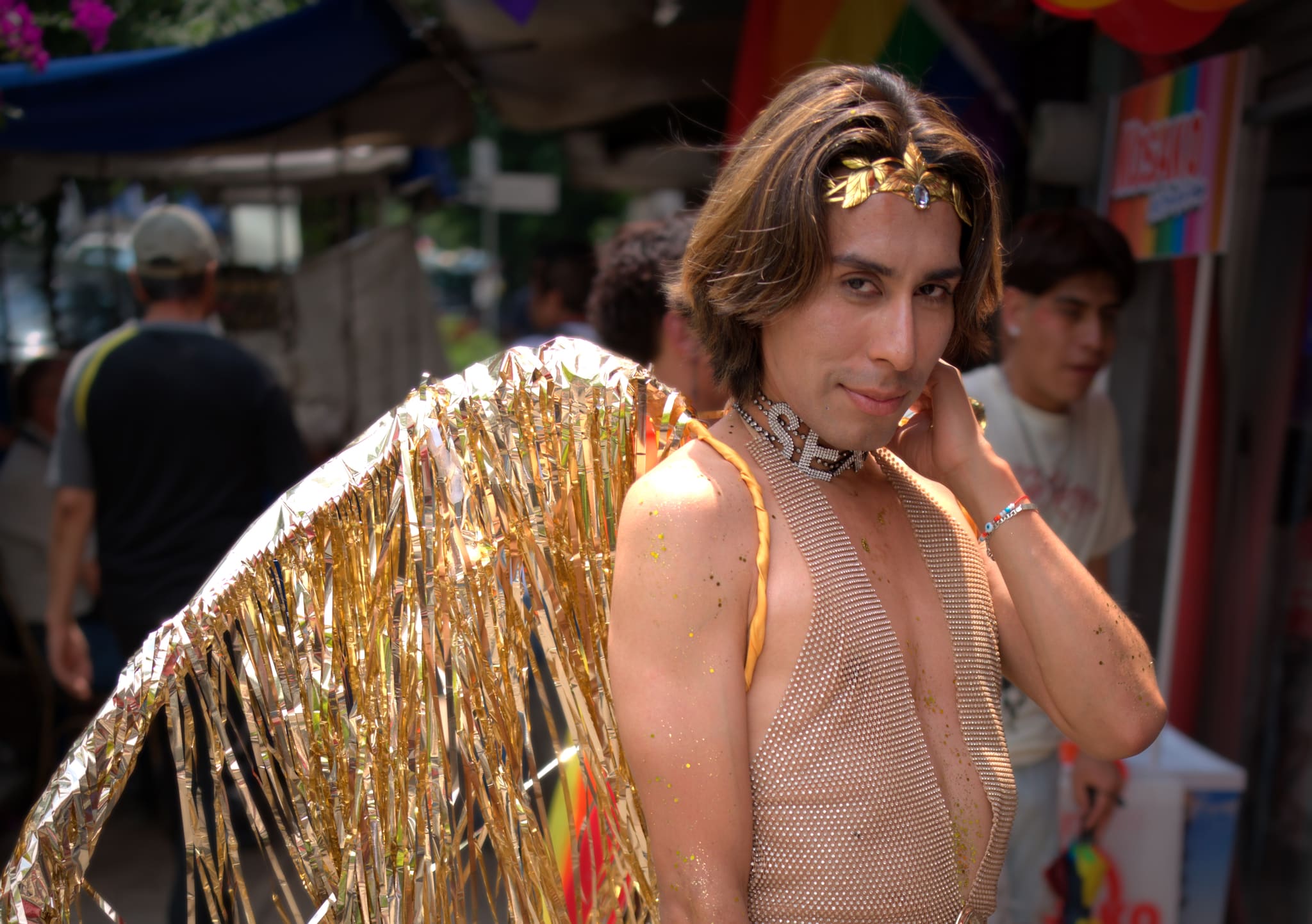
Wings everywhere. Foam feathers, mylar, wire and glitter — angels of every genus, as if the Ángel up the avenue had been quietly recruiting. A figure in gold turned an over-the-shoulder glance at my lens with the composure of someone who has already survived the thing you're worried about. A pair of queens outside the Metro station posed arm in arm, fishnets and white sneakers, fantasy standing in ordinary street light like it had always lived there.
And then, between floats, a harlequin passed close to the curb — purple silk, white-painted face, a rainbow umbrella resting on her shoulder. She wasn't performing for anyone in that moment. Her eyes were down. Whatever she was feeling lived somewhere behind the paint, and she carried it through all that noise the way you carry something you've decided not to set down.
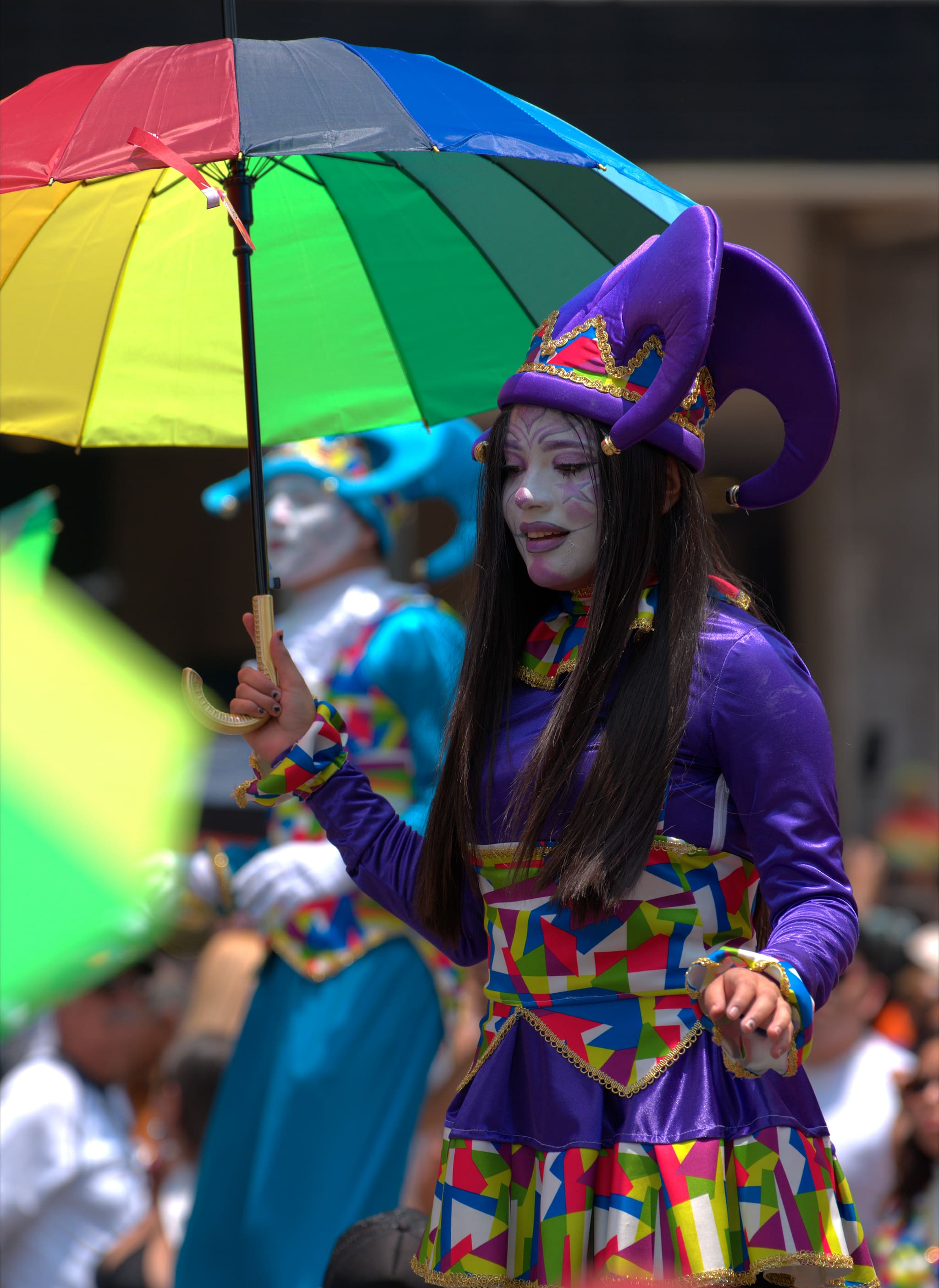
I photographed her too. Of everyone I saw that day, she is the one I recognized.
Because I was also in costume, in my way — the camera is a costume, if you hold it right. It gives you a role at a celebration you don't know how to enter. It makes the distance look like a choice.
Here is the part that is harder to say.
I was not at the edge of the march only because of the crutches, or the lateness, or the camera.
I live at the edge. I have lived at it for a year and a half.
I came to this city to be safe, and I am — safer than I was, safer than my country of birth was preparing to let me be. This city took me in. I wrote once about the chain of people who chose to see me here, and every word of that is still true.
But there is a distance that safety does not close by itself, and it is made of smaller things than danger. It is made of syntax. Of the tense I reach for and don't find while somebody waits. Of the joke on the speaker truck that lands around me like rain around a doorway — everyone wet with laughter, and me dry, a beat behind, asking my love later what it meant.
Spanish is coming to me the way a coastline comes to a swimmer: real, and slow, and further than it looks. Until it arrives, some part of every crowd is a photograph already — beautiful, legible, and on the other side of glass.
I have gone out alone here exactly once — a movie with my sister-in-law, my first time riding the Metro by myself. On a train packed too full to turn around in, a stranger's hands taught me, three stops in, why the women-only cars at the front of every train exist, and why women run the length of a platform to reach them. I got off knowing two new things about this city: that I could cross it alone, and one of the reasons I hadn't.
I have not gone out alone since. Some of that is arithmetic: a woman like me, a camera worth more than it should be, streets I cannot yet ask questions of. Some of it is older than this city and came here in my luggage, and some of it is as recent as that train. I am not sure, on a given morning, which is which. Fear does not itemize.
And now the person who walks beside me cannot walk. The one who carries half of every errand, who speaks for us both when my words run out, is on the couch with their leg raised, healing, apologizing for it — as if a broken street were something a person could fail at. So the doors I already found difficult are now doors I stand in front of alone, doing math with my courage, while somewhere behind me the kettle needs descaling and the pharmacy needs visiting and the residency clock keeps its own quiet time.
There are days the load is a list, and days the list is a weather.
I am telling you this for one reason. From the outside, a life like mine this month could be misread in either direction — as a woman failing to cope, or as a woman who has it all handled. Neither is true, and both are lonely. The truth is only this: the load is real, and I am carrying it, and rendering it clearly enough to be seen inside it — that is not a complaint. That is the same thing the march was doing, one avenue over, at the top of its lungs.
To be seen without being simplified. That is the whole ask. It always was.
Near where I stood, a rose garden opens off the avenue, and at the back of it stands a long black wall.
The wall is covered in names, written by hand, in chalk and paint. Víctimas de feminicidio. Women murdered — some whose names a whole country has marched behind, most known fully only to the people who loved them. The letters are uneven. Different hands. Some names have hearts drawn beside them. Some have flowers climbing the metal from the garden, as if the roses had decided to help.
Four men from the march stood in front of it, reading. One wore tie-dye, one a rainbow bandana, one a little crown. Somebody held a drink. They had walked out of the loudest celebration in the hemisphere into this square of quiet, and they stopped, and they read the names, and nobody checked a phone.
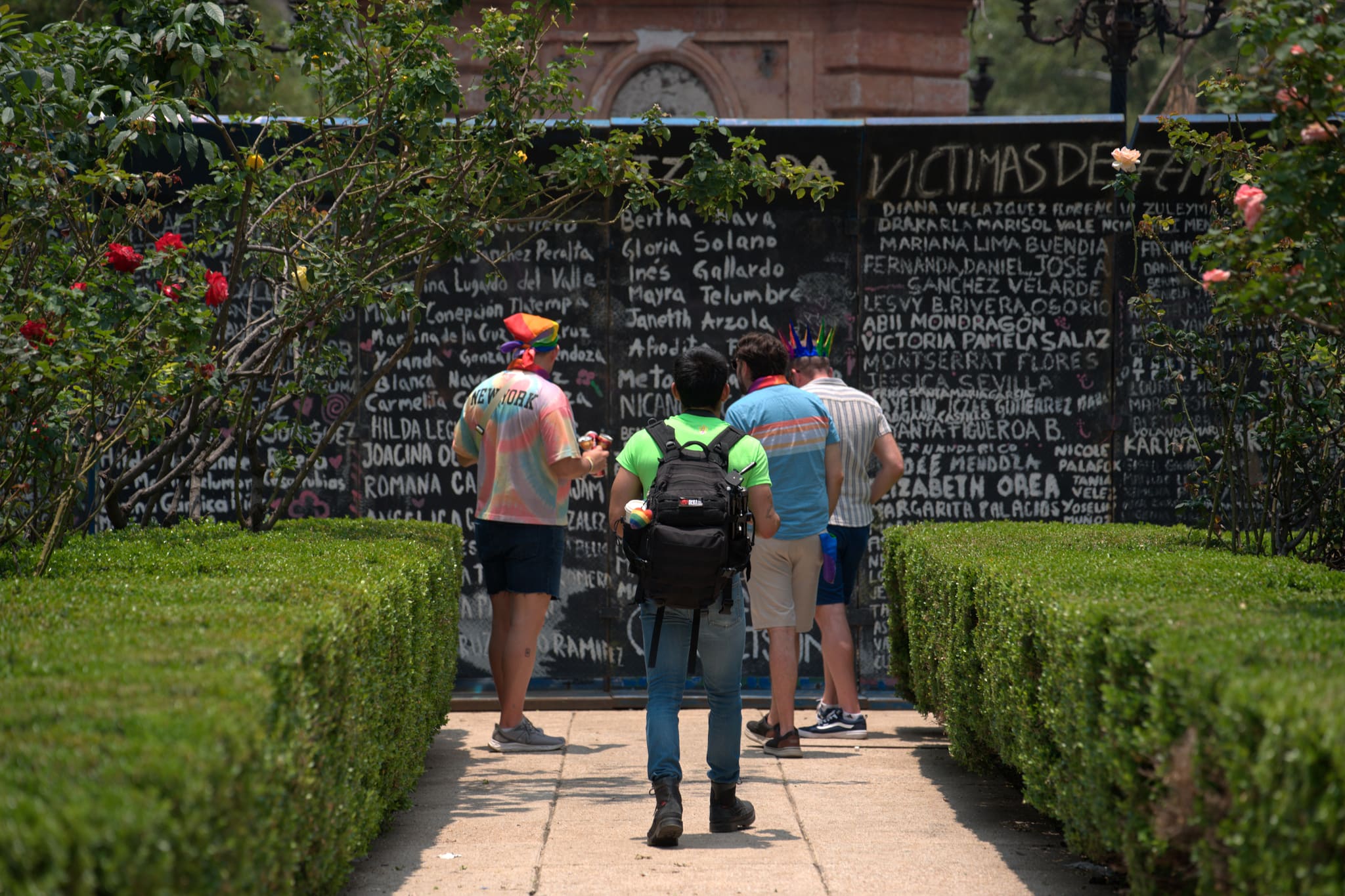
From the moment the march moved without me, I had been grieving a thing I thought I would miss: the Tramo del Silencio, the stretch of the route where every contingent — the floats, the speaker trucks, the drums — goes silent, block after block, for the ones who were killed for being what the march celebrates, and for the ones who are still missing. I arrived too late, I thought, to see the silence.
I was standing in it.
The silence was never a place on the route. It is a discipline this city keeps: the refusal, in the middle of its own joy, to let the dead be unnamed. The wall is that refusal in chalk. Someone rewrites these names when the rain takes them. Nobody is paid to do it. It is simply done, again and again, because here the names are the memorial — not marble, not statute. A hand, writing.
I photographed the wall and the men reading it, and I understood something about the papers I have been dreading, though I did not have words for it until later.
There is documentation that erases, and there is documentation that refuses to let you be erased. A government can print a name that is not yours. And a stranger with a stick of chalk can write a name that is — and rewrite it after every rain, for years, for someone she never met.
Both are records. Only one of them is true.
The chalk does not outrank the passport in any office in the world. But I have stood in front of both now, and I can tell you which one felt like it was holding the world together.
There is a stretch of this march I cannot show you.
Somewhere along the route, earlier than I could arrive, the music stopped. Every truck, every drum, every whistle — contingent after contingent falling quiet as they crossed it, for as long as it took to cross.
I have no photograph of it. I was fitting crutches to the arms of someone I love.
So this is where my essay goes quiet too. Not because there is nothing to say. Because some things are honored by the place where you stop being able to say them.
For the ones the march remembers. For the ones still missing. For the names the rain keeps trying to take.
—
We walked home before the march ended. It ends late; it always does. Somewhere behind us a stage was still being sung from, and the Zona Rosa was only beginning its long bright night. But neither of us wanted Alexis alone too long, this early in the mending — so we left it all mid-sentence, Raziel and I, two thousand photographs between us, and walked back to the neighborhood, where the sound of the city returned to its ordinary Saturday self, block by block, like weather clearing.
Alexis was on the couch where I'd left them, leg raised, exactly as instructed for once. I showed them the day on the camera's small screen — the wings, the signs, the woman under the purple umbrella — and watched them meet all of it secondhand, the way I have met so much of this country: at one remove, through a pane, wanting in.
We are teaching each other, it turns out, how to live at a distance from things we love, and how to close that distance slowly, at the pace healing actually goes.
That same afternoon, their sister came.
She fussed over the leg, and told stories, and the four of us — Alexis, Raziel, Erika, and I — shared a meal while the march we'd left was still moving, somewhere south of dinner. And while we ate, I let her read the essay I wrote in May — the one about the chain of people who chose to see me. I have never formally told her what I am. I didn't need to; the essay says it, and she read it at our table while I pretended not to watch her face.
When she finished, she thanked me for trusting her.
That was all. She did not treat me differently on her way out than on her way in — unless closer counts as differently. One more link in the chain, added quietly, over a shared meal, on the very day the city marched.
And then, at last, the day the whole weekend had been owed: Monday, off work, nowhere to be. Alexis and I in a bed full of late morning light, crutches leaned in the corner like a bicycle after a long ride. Outside, the city swept up its glitter. The residency clock kept its quiet time, the pharmacy list waited on the counter, and none of it was owed a single thought before noon.
The march is a river, and I stood at its edge. But this — this is the sea it was always running toward. Two people, resting, seen, home.
I named this essay's older sister Vernos — to see each other — and I find, arriving at the end of this one, that I have written the same essay twice. I suspect I will keep writing it my whole life, the way a lighthouse keeps writing the same sentence on the water.
That one was about being seen: the chain of people, on both sides of a border, who looked at my paperwork and chose to look at me instead.
This one, I thought, was about a march. It wasn't. It was about what seeing turns out to be, in a week when everything asked for it at once.
Seeing is a woman under a purple umbrella meeting a stranger's lens, and letting it matter.
Seeing is a friend who stays the night, and picks up the phone where your words run out, and walks you to the river's edge so you don't stand there alone.
Seeing is fitting crutches to the arms of the person who carried you for years, and calling it — because it is — an honor.
Seeing is a city that goes silent, block by block, in the middle of its loudest joy, because somebody's daughter is still missing. It is a hand rewriting chalk names after every rain.
Seeing is a sister reading an essay at your table and saying only thank you for trusting me — and treating you no differently on her way out than on her way in, except closer.
And some mornings, seeing is a document I do not want to think about before noon, and the knowledge — hard-won, chalk-taught — that whatever letter a government prints beside my photograph, it will be outvoted. It has already been outvoted: by a march, a meal, a friend, a sister, a love asleep beside me, a stranger under an umbrella. A state can misfile me. It cannot make me unseen. That is not something it has the power to take, because it was never something it had the power to give.
I wrote this because a life like mine, this month, cannot be explained across a dinner table — it comes out as either drowning or fine, and it is neither. Some things have to be rendered to be seen at all: softly, because they are heavy; clearly, because the clarity is the point. This essay is me stepping, for once, out from behind the camera. One more face in the crowd, turning toward you.
So here I am. Seen, I hope, without being simplified.
And if you have read this far, then you have already done the only thing these words were ever asking.
You have my thanks. And my hand, extended —
the way this city taught me.