Essay 3
The Luckiest of My Unlucky Class
A one-letter answer from my government, opened in the rain outside a courier office — on hope, luck, and why the ones who can still write have to.
Ciudad de México — August 19, 2026
I walked out of the passport office holding an envelope I had spent nineteen months preparing to open.
I knew what I had put on my application, and why. In the first days of 2025, my government ordered that every United States passport must carry the sex its bearer was assigned at birth — that any renewal, any replacement, would be reverted to it, regardless of the life attached. I knew what the policy said, and I knew, with near certainty, what passport I would receive back. So I documented everything. I applied for renewal with exactly the information my old passport already carried — the name I have worn for more than a decade, the face I have earned, and one letter: *F*. I marked it knowing they would override it. And I knew that in overriding my will and my intent, they would prove, in their own ink, my country's failure to honor my right to exist as my authentic self. So that if it ever came to it, I would stand before the courts of Mexico — my home now — with a clean record: my request, and their denial.
None of that could prepare me for the reality of walking out of that DHL office with the envelope in my hand.
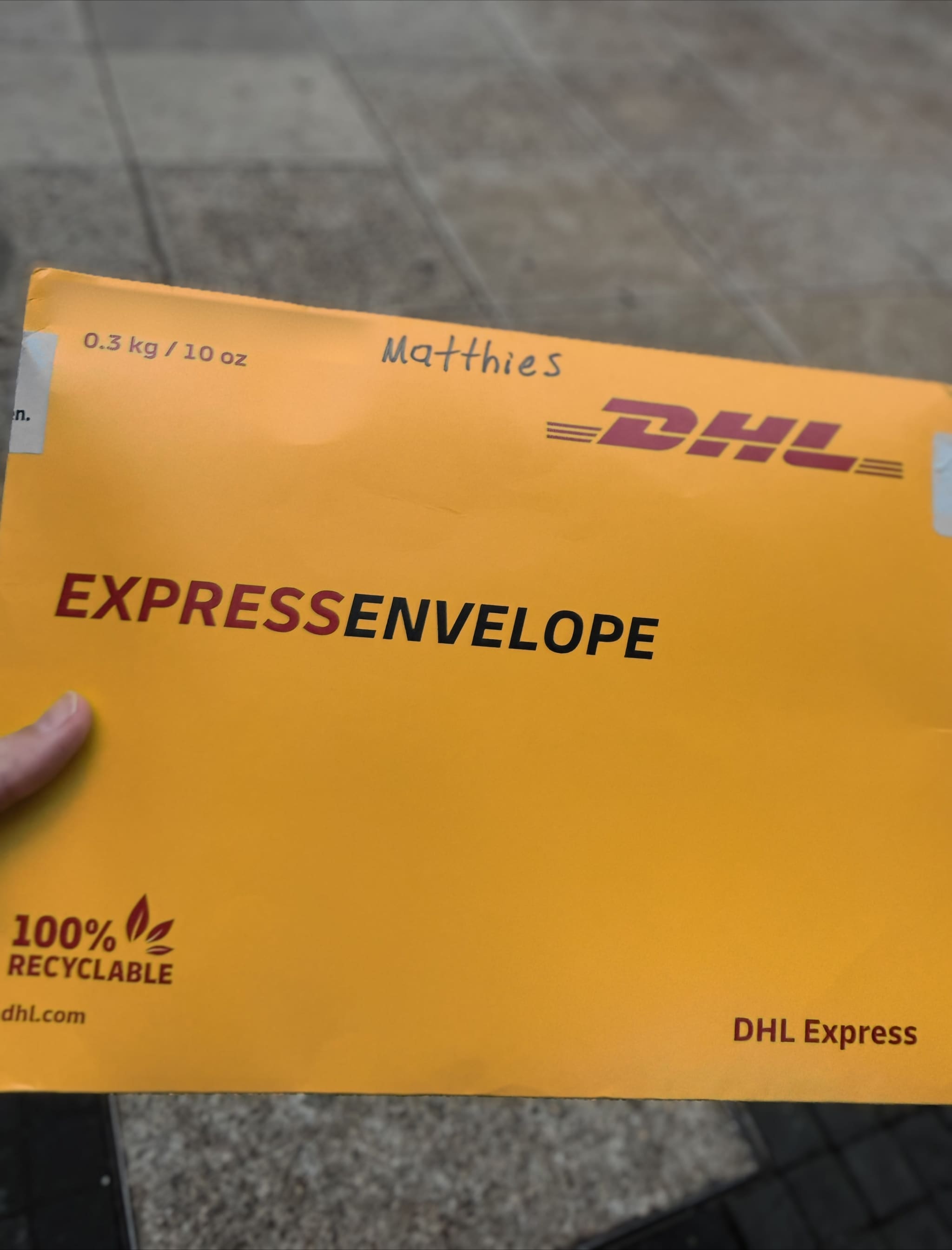
I stood in rain that was becoming less and less intermittent. My partner, Alexis, took my phone and pointed it at me and the envelope — because months ago, in a steadier mood, I had decided this moment should be witnessed. I had done and thought all of it, over weeks and months of preparation. And in that moment, none of it mattered. Because hope was still alive in me. Not hope in a strong legal argument. Hope that compassion, somewhere in some human heart, could still override policy. That someone might simply fail to look that hard, and renew my passport with the same marker it had already carried for ten years. Ten years of life lived in an identity I call my own. Ten years in which every record, at every level, matched my lived experience, and no one questioned it any longer. A lifelong battle finally behind me — a life of adventure and freedom and passion to do some good in the world, open in front of me.
But the world changed. And I had clung to hope so deeply that I didn't realize how far down its roots went.
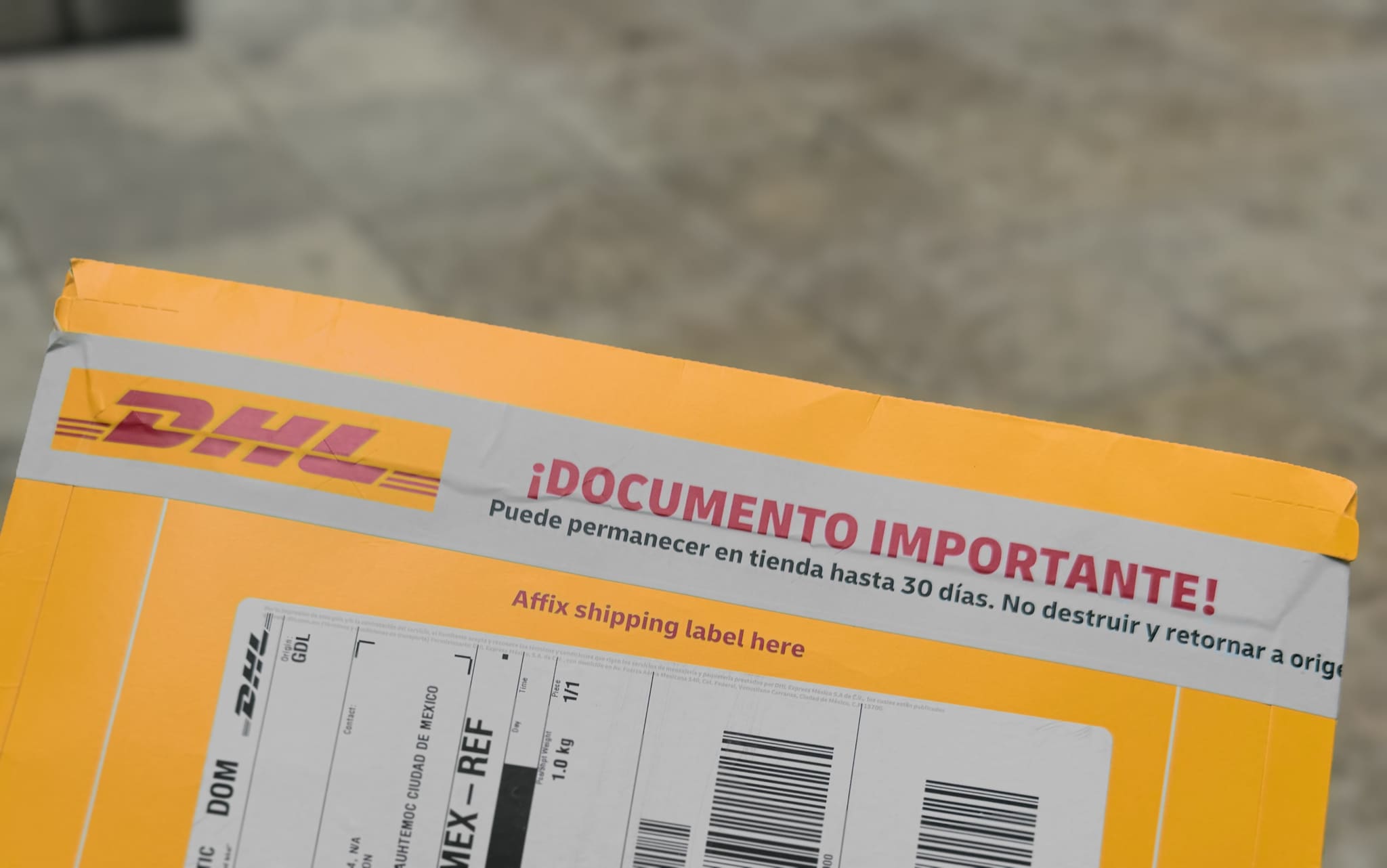
I pulled the little cardboard tab at the top of the envelope and heard it open — the soft vibration of the tearing. Inside I found my old passport and passport card first: cancelled now, and still, on their faces, true. Beneath them was another envelope with its own seal, from the office that prints the new ones. I unsealed that one too. And there they were. My new documents. I took out the passport and opened it to the page that mattered.
*M.*
They did exactly what I expected they would do. But another part of me had believed, illogically and against all probability, that by some fluke or some person's compassion I would be the exception. That I would be lucky. That hope, for that one specific mercy, had been keeping me suspended above the full weight of rejection and erasure. And in that moment, it died. Not all my hope, about everything. Just that one very important part. A light inside, extinguished by ink on a page — a page that is supposed to tell the world who I am as I go out into it, trying to reduce suffering.
The light went out. Cold and grief came in. The rain grew stronger. Then thunder, as if on cue.
I wanted to be home, in bed, away from all of this feeling. I opened the rideshare app and summoned a car. Seventeen minutes. So I stood there outside the DHL office, trying to process it all: how a world could be so cruel as to take from me a truth I had to fight my entire life to have recognized. A truth I could only claim after overcoming my own inner fears and my own internalized self-hatred — hatred put there not by me, but by others who felt they had the right to decide which truths can exist and which cannot. And now it was being revoked yet again. Not emotionally, this time, by people whose support I needed. Legally — by the people who control my very ability to cross a border as myself.
I checked the app. Twenty-three minutes now. The rain came harder.
I messaged some friends and the people I work with. Everyone was as supportive as anyone could ever be expected to be — grieving with me, for a world that isn't like this. They wanted to comfort me. I wasn't ready to be comforted. I just needed to make it home and exist with this. All of this. To re-anchor my hope — yet again. To refuse to give in to the darkness — yet again.
I should tell you what the darkness actually says, because it does not speak in abstractions. It speaks in the voices of my childhood — the ones that wait for night to tell me I am not really a woman, only confused. I was taught that lesson early and thoroughly, by a world that had decided who I was allowed to be before I could read. The people who taught it were not villains; they were survivors of inheritances I have only lately begun to map, small traumas compounding across generations until they became the households that raised the people who raised me. But a child cannot see the lineage. A child just learns: you are wrong to exist. And the voices that teach that lesson do not leave when you grow up. They move in.
What finally broke their monopoly was not willpower. It was evidence. When the letter on my documents changed, ten years ago, it was never paperwork to me. It was the seal of the country that raised me, entered into the oldest argument of my life — on my side. See, I could finally say to the child who keeps the ledger: you are allowed to exist. You are not wrong. You are not confused. Even they say so now. My family began, slowly, to soften — tolerance, mostly, and mostly respectful, but real — and I think part of why is that the world accepted me first, and made me harder to dismiss. And I want it said plainly, because the voices are not the whole story of that house: I love them. I know that I am loved — even when they do not know how to say it — in all the ways they know how to show, even when those ways are not the ones I need. They are trying their best, too, inside a lifetime of being haunted by their own traumas. The documents were never the whole shield; I had people who loved me into being. But they were structural. They held a line at three in the morning that love alone had never quite been able to reach.
So when someone asks what a letter on a passport could possibly weigh, this is the answer. The government that once armed me against those voices has switched sides in the night war. The counter-exhibit has a newer date and an eagle on the cover, and the voices know how to read. And I do not think my story is unusual in this — that is what makes institutional withdrawal so much heavier than it looks from outside. So many of us spent decades fighting past inner barriers built by people who swore we had no right to exist, and the recognition, when it finally came, was not a convenience. It was the proof we used, against ourselves, to end the war. Take it back, and the war does not resume where it left off. It resumes everywhere at once, at night, in a voice you have known since childhood. I know that voice now — well enough to know she is not the enemy. She never was. She is a child repeating what she was taught, by people repeating what they were taught, none of it the fault of any one person, all of it the dependent origination of the very self I am. You do not win against a hurt child. You heal her. You sit with her at three in the morning and say what no one said. That is what the fight actually is — not a war against her, but a long tending of her — and I know how to do it now. Many of my friends are doing the same tending with less — less shelter, less help, less luck.
And the war is no longer only internal. The letter now outs us at every border on earth — to every officer, every airline agent, every database that copies it forward — for as long as the document lives. In the wrong room, in the wrong country, that disclosure is not humiliation; it is danger. Every crossing is a lottery ticket none of us bought, redeemed in front of a stranger with state power, the odds set by geography and by whoever is holding the stamp that day. And some of us, knowing the odds, will simply stop crossing — the conference declined, the funeral attended by screen — a travel ban administered by fear, the one harm in all of this that leaves no evidence behind. I documented everything. Even I cannot document a flight that was never booked. Unlucky was never a feeling. It is a distribution.
Because I am the lucky one. I am one of the luckiest of my unlucky class. I had the resources to relocate to another nation just to try to find peace. I have a partner standing beside me in the rain, a lawyer who answers within minutes, work that gives my life meaning, a city that has been kind to me. And for every ounce of pain that was burning through my soul as that one light went out, another trans person — one who could not leave, with fewer resources and less of a support system — is feeling it doubled or tripled tonight, and often alone. For that reason, I — of all trans people — have a responsibility to claw myself back to stable ground yet again, and write. Because for every one of us who finds the strength to share their experience, a hundred more never get this far. They suffer quietly, often alone, and some of them lose the fight to keep living — and become another name written in chalk on a wall, to remind the rest of us why we have to keep going, so that no one else meets that end after us.
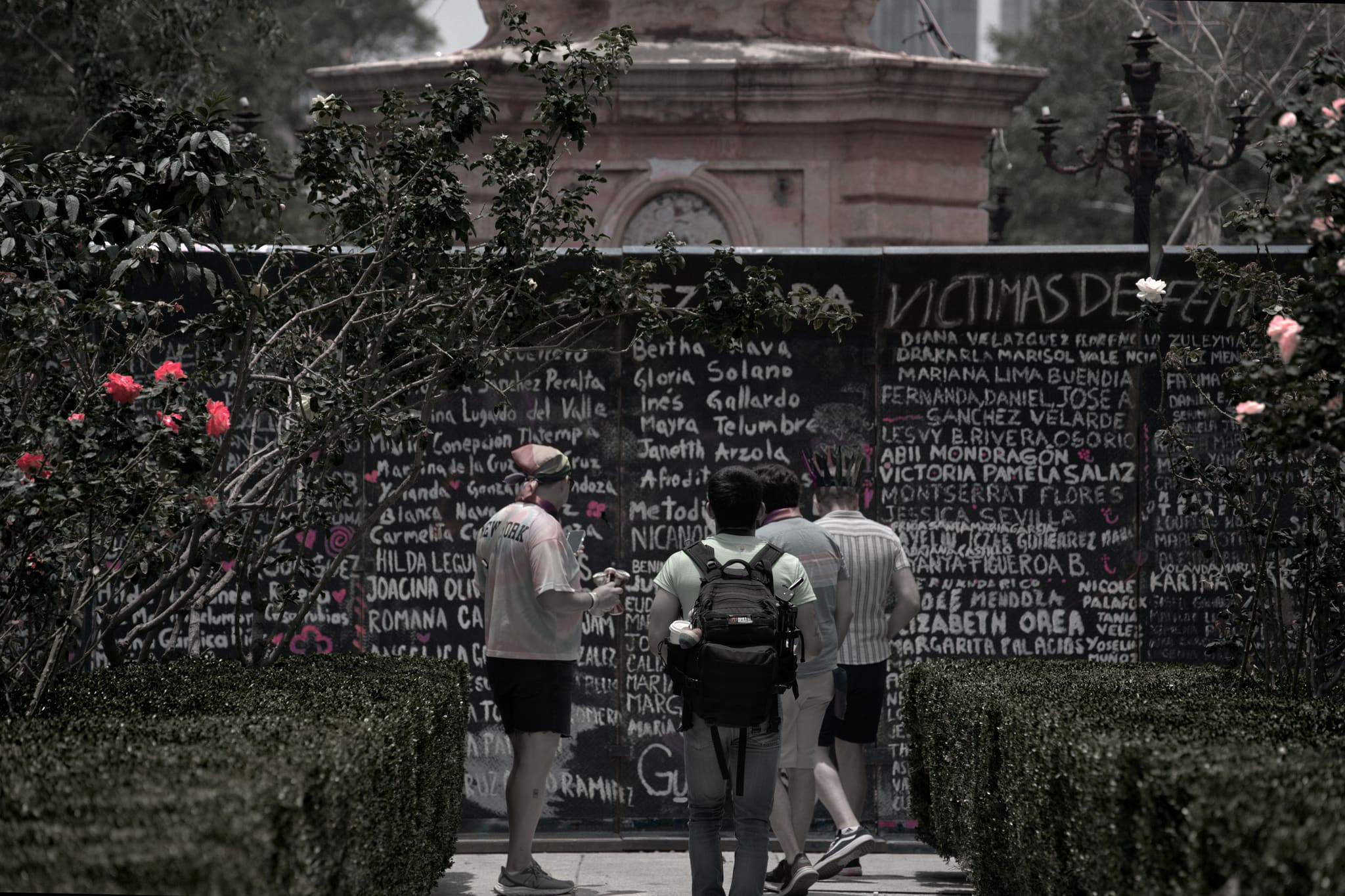
There is such a wall a few steps from that DHL counter, at the back of a rose garden off the avenue: the names of women this country's institutions failed, written by hand, hearts drawn beside some, roses climbing toward others. I wrote about that wall once, in a happier essay, watching four men walk out of the loudest celebration in the hemisphere to stand in front of it and read. I did not expect my own paperwork to route past it. Twice.
I checked the app. Thirteen minutes.
Water is pouring down now, and puddles have filled the streets and sidewalks. I stare up at the buildings across the street while Alexis holds me. The tears are trying to force themselves out. I am not ready to accept them yet. I sit inside all the emotion undoing things in me, and all the hope trying to redo them in new ways — years of learned resilience re-establishing itself before hopelessness can settle in. Because I have been hopeless before. Deeply and darkly hopeless. And where there was no hope of anything beyond the darkness, somehow, light found a way. It has found a way every time since. So the darkness has never hurt me as deeply from that point on. It was not going to win tonight either. But for a few minutes, in the rain, it was allowed to be felt.
I checked the app. Three minutes.
And then — oh no. The car was arriving on the other side of one of the widest streets in Mexico City that isn't a highway.
So we ran. We splashed to the crosswalk and across the flooded road, shoes filling with water, clothes soaking through, no shelter left and no longer needing any. We reached the far side just as our ride rolled past us, stopped halfway down the block, and waited. We ran that last stretch too.
I realized afterward that our driver had probably watched the whole thing in his rear-view mirror, mortified — the two of us, drenched, running toward him through the storm from the place where he'd been a moment before.
I tipped him two hundred pesos in cash, so that at least one person didn't have to lose hope that night.
Then I went upstairs, peeled off my soaking shoes and clothes, and sat down to make meaning out of meaningless suffering.
This is close to the last essay I ever wanted to write. Given the choice, I would spend these pages on the beauty of this world — on the kindness that carried me here, on the work I love, which is trying to make the natural world around us a little more legible. Those essays exist, and there will be more; I refuse to let one letter become the defining part of my story. But the difficult thing to write and the right thing to write are sometimes the same thing. Publishing this costs something — Alexis and I counted that cost, and the answer we kept arriving at was: write. So here I am, at the desk, in dry clothes, with the storm still on the windows.
Here is the meaning I have, so far.
The voices of the night are trained, and you do not out-argue training. You counter-train. There are two voices I have spent years deliberately installing against the dark, and if part of this essay was about the war, this part is about the armory. The first is the voice of compassion — I learned it in the figure of Quan Yin — the one that says: what you feel is allowed to be felt. You are not weak for breaking; you are carrying something heavy, and you have carried it a long way. That voice already spoke once in this essay, in the rain, when the darkness was allowed to be felt instead of fought. The second is the voice Joanna Macy called active hope: the discovery that hope was never a feeling you wait to receive, like a forecast. It is a practice. You do not need optimism to do it. You choose the direction you intend to face, and you act toward it at whatever scale is left to you — and the acting itself is what regrows the hope. Two hundred pesos is active hope. A chalk heart drawn beside a name is active hope. So is this paragraph.
I am telling you this because these two voices are how I got this far, and they are how I intend to carry on through a time when everything is heavier than it has felt in years. And because the same institutions withdrawing their recognition of people like me would very much like our inner voices to follow their lead. That is the quiet second half of every policy like this one: the outer revocation wants to become an inner one. It does not have to. The counter-voices can be reinforced on purpose — that is the entire lesson of my survival — but they are not self-installing. Someone teaches them. Friends who cared taught me.
So here is what I ask — and I am asking everyone, whoever you are, whatever your background. Look to the most vulnerable people you know today: the ones with less luck than me, less shelter, no lawyer who answers in minutes, no partner in the rain. Maybe the person who needs to hear it is a friend. Maybe they are just someone you pass on the street one day. Or maybe that person is you. And teach them these voices. Say to them, in whatever words are yours: what you feel is allowed to be felt. You are allowed to exist. Hope is something we will do together, at whatever scale is left to us. Say it more than once — training takes repetition, and the other side's has a head start. You will be helping rebuild a shield that a government took away. And it turns out that kind of shield was never really made of governments. It was made of voices. It can be made of yours.
This is that attempt.
---
The rain in this essay is real — recorded from our roof, in another storm. The street beneath it is someone else's recording, freely given. The thunder arrived the same way. The envelope's tearing is the actual tearing, from the video Alexis filmed in the rain.